
Disasters keep coming. Will your jurisdiction be ready to act on its own?
AidKit gives state and local governments cash assistance infrastructure that puts money in survivors' hands within 48 hours. Build for faster recovery with minimal commitment and less reliance on Washington.
Recovery from one event now overlaps with the next. The communities that survive that reality are the ones who have their own infrastructure ready.
Get the disaster recovery brief


The window for preparation has collapsed. The window for response hasn't.
Billion-dollar disasters now strike every 10 days on average, and the past three years are the worst on record.
Back-to-back emergencies drain local budgets, stretch staff thin, and leave survivors waiting weeks for help that should arrive in hours. And with federal disaster funding increasingly uncertain, communities can no longer afford to wait for Washington to act.
The jurisdictions that are getting ahead of this aren't working harder. They're working with better infrastructure.
Back-to-back emergencies drain local budgets, stretch staff thin, and leave survivors waiting weeks for help that should arrive in hours. And with federal disaster funding increasingly uncertain, communities can no longer afford to wait for Washington to act.
The jurisdictions that are getting ahead of this aren't working harder. They're working with better infrastructure.
A roadmap built for the reality you're actually facing
Leading jurisdictions are rethinking how disaster financial assistance is delivered. This brief gives you a concrete framework for:
Prepositioning infrastructure before disaster strikes, so you can activate in hours.
Reducing administrative burden during response, even with a skeleton crew.
Coordinating across agencies and funders without starting from scratch each time.
Delivering aid that's fast, flexible, and dignified, directly into survivors' hands.
Recovering more fully before the next event arrives.
Download the brief

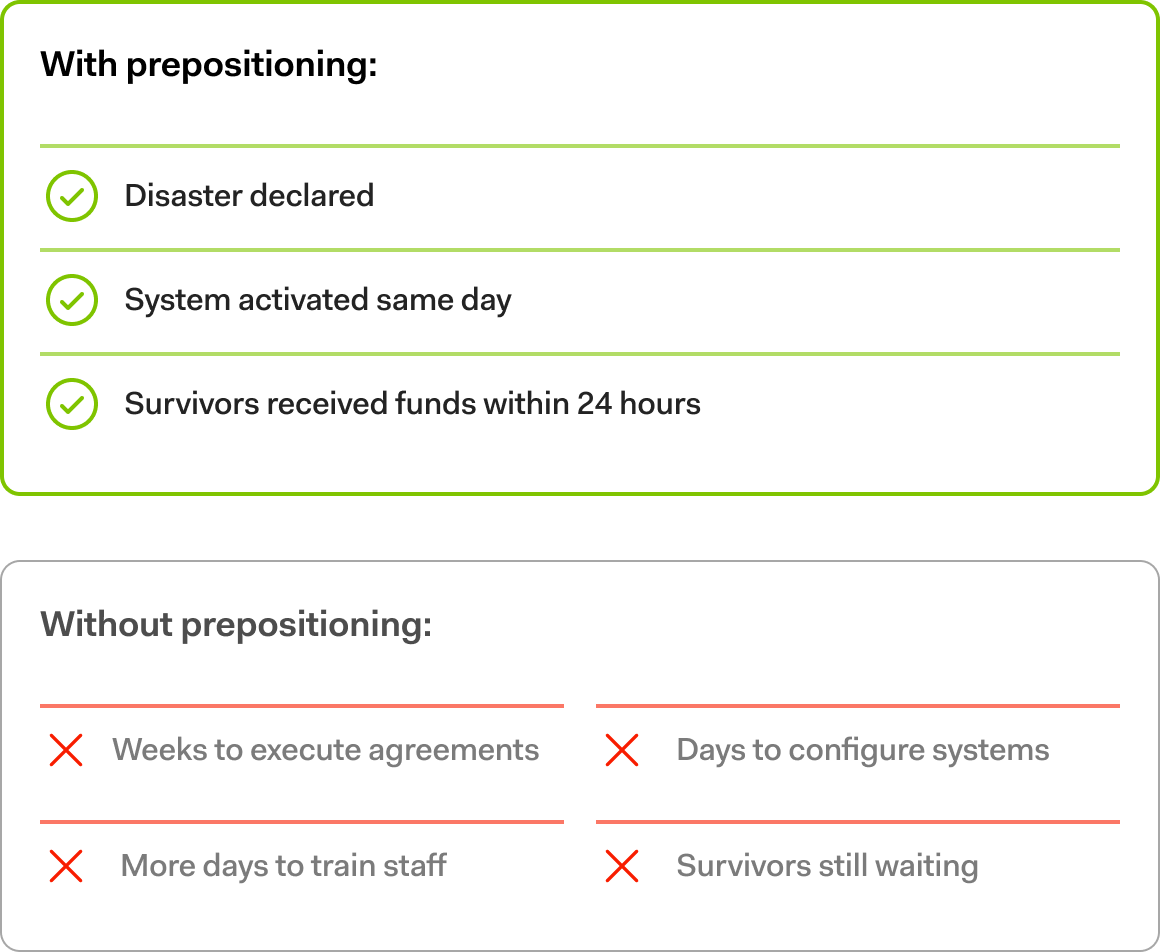
Your community deserves infrastructure that works when it matters most.
True readiness is infrastructure that holds up when budgets are stretched, staff is overwhelmed, and federal support is slow to arrive.
This is what prepositioning allows you to do:
Protect staff capacity during overlapping crises
Maintain continuity when leadership changes
Reach survivors at the moment they need help most, not weeks later