.svg)


Featuring
.jpeg)
We've lived through a massive shift over the past decade, one that human services leaders and nonprofit directors know intimately.
Disasters and major emergencies used to be relatively infrequent. When a community was faced with a catastrophic event, everyone would band together and find a way through the madness, with some of the most dedicated and empathetic people in the community doing whatever it took to help their neighbors. I know, because I've been there.
When I was the Executive Director of a New York-based nonprofit during the pandemic, I stayed up until 3 o’clock in the morning several nights a week to write donor appeal letters and coordinate resources. I met daily with the local coalition of nonprofit, faith-based, community-based and charitable organizations, then weekly, and assembled emergency food packages with my toddler running circles around me and my daughter strapped to my back. I saw the local Department of Social Services director on daily Zoom calls, heard updates on hospital transport needs from our United Way director, and tracked how many seniors were stuck at home waiting on food deliveries. Together, we activated in the most profound way: delivered food and money, lined up medical transport, and stopped at nothing to ensure the people most left behind in our communities were helped. It was formative for me as a mother, a worker, and a member of a community.
"The experience of helpers all over the country has been that emergencies like the pandemic are no longer exceptions. They are the new normal."
That experience gave me a front-row seat to the challenges of aid delivery. Since then, in my role as CEO at AidKit, I have worked with nonprofit and government agency directors all over the country. They've taught me that my own struggle (read: fighting with spreadsheets in the wee hours of the night to deliver aid) was not unique. Most social sector leaders operate with limited capacity, tight budgets, and constantly evolving demands even when the skies are blue. When disasters and disruptions occur, these public servants are expected to pull capacity from thin air or reactively hire to pull off complex operations with real consequences.
Unfortunately, the experience of helpers all over the country has been that emergencies like the pandemic are no longer exceptions. They are the new normal. Emergency food, rent, and cash assistance infrastructure has become a permanent necessity because nobody has the emotional bandwidth or the nervous system resilience to rebuild chaotic spreadsheet workflows from scratch every time a disruption hits.
Since the pandemic, state and local governments have continued to face significant increases in emergency needs, compounded by federal funding cuts. Feeding programs and farm supports got hit hard and early in the second Trump administration. The federal freeze of the Supplemental Nutrition Assistance Program (SNAP) in November 2025 was a profound emergency and existential crisis for many families. The Low Income Home Energy Assistance Program (LIHEAP) was threatened and defunded, resulting in the loss of all its federal staff. Most recently, there has been a pullback in the Special Supplemental Nutrition Program for Women, Infants, and Children (WIC). Some localities have had to absorb natural disasters on top of all of this, from the devastating January 2025 wildfires and windstorms in Los Angeles, to Hurricane Helene, the Texas floods, and the Washington floods of late 2025, to name a few.
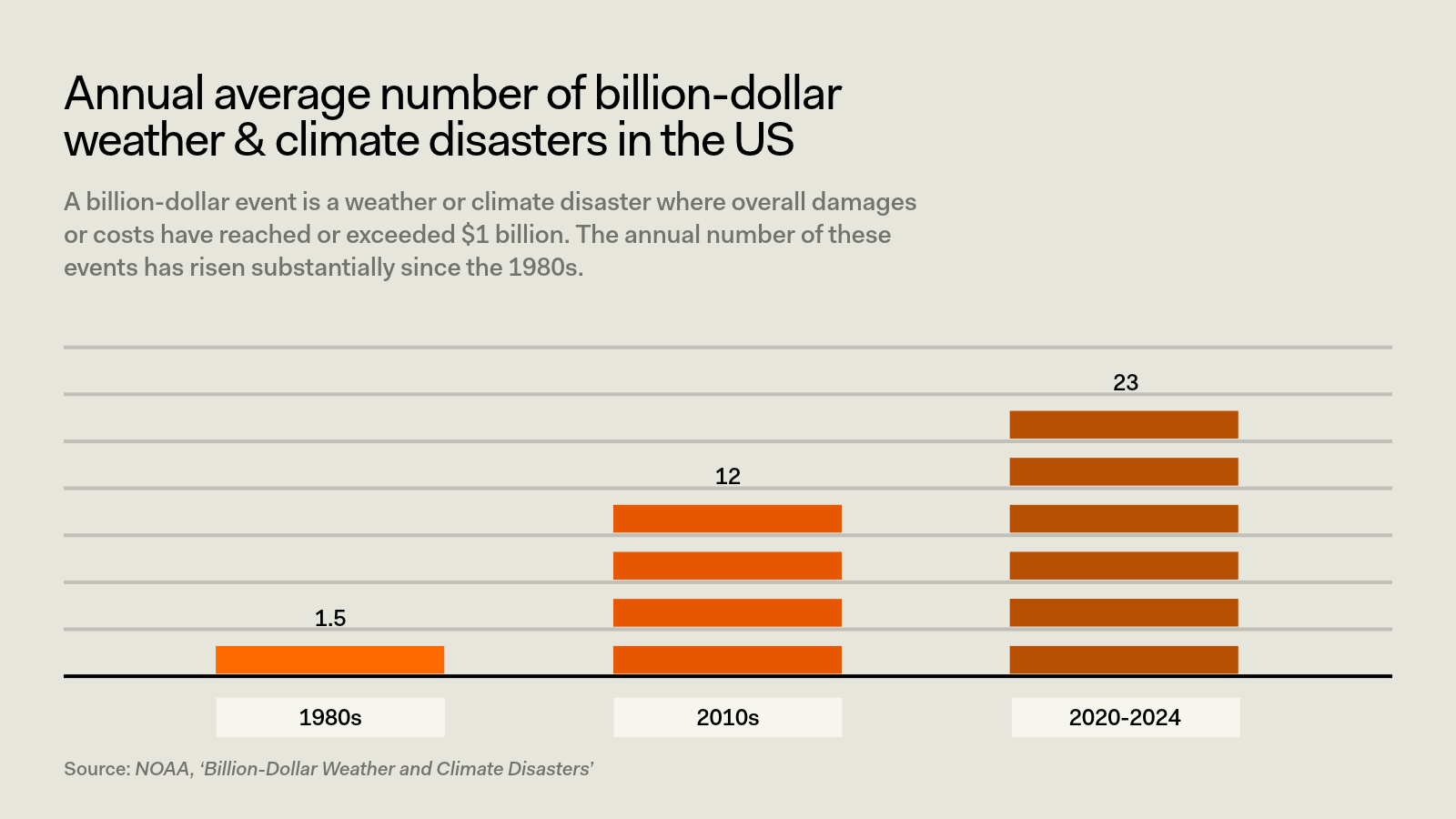
Globally, the number of billion-dollar disasters has risen dramatically. In the United States, NOAA data shows the annual average rose from 1.5 events per year in the 1980s to 12 in the 2010s and to 23 per year from 2020 to 2024. And with climate change risks being denied and federal mitigation facing political and funding setbacks, the risk profile is unlikely to improve.
Local leaders are tired. They have been called on to perform heroic acts too many times, with diminishing support and no relief in sight. As a sector, we are done with a reactive posture. It is time to build durable systems that recognize that operating through chaos is not only possible, but expected.
What becomes possible when the infrastructure is already in place
Something remarkable happened in the aftermath of four separate crises packed into four months last year: Hurricanes Helene and Milton, the Los Angeles County wildfires, a wildfire in Fresno County, and a government shutdown that froze SNAP benefits for families who had no margin to wait. Across all four, Save the Children US used a single, standing technology platform to move over $2 million in emergency cash assistance directly to more than 4,000 families and 10,000 children across 22 states.
Within hours of each response, their platform was verifying identities, confirming eligibility, and moving funds. On average, programs went from design to cash in hand in just two days.
It only worked because someone made one deliberate decision before any of those crises arrived: they worked to set up the infrastructure first.
The sequence matters more than almost anything else I've learned working in this space. The proven system was set up before the instability hit. That's the whole thing. That's what it takes to get disruption response right.
Delivery depends on aid infrastructure
Many organizations and agencies focus on funding as the primary need when a disruption occurs. Funding is the fuel, but operational capacity and infrastructure are what’s needed to actually get aid where it needs to go. You can get authorization for every dollar and exceed all your fundraising targets, but that money will sit in an account if you're not prepared to implement your aid programs.
I have seen what this looks like in practice: public servants managing intake through Google Forms; case management systems tagged onto donor management tools in Salesforce, stretched past anything they were designed to do; inboxes full of paystubs and license photos, creating a major compliance risk, with sensitive documents sitting outside the case management platform and no way for the systems to talk to each other; and staff left manually downloading and uploading thousands of documents a day. These taped-together systems aren't failures of effort or creativity. They're what dedicated people do when the tools aren't there. They make it work. They always make it work. And it costs them enormously.
The families those workers are trying to reach can't absorb that cost either. A family living paycheck to paycheck cannot afford to wait for an administrative backlog to clear, while rent is due and the utility shutoff notice is sitting on the kitchen table.
"As a sector, we are done with a reactive posture. It is time to build durable systems that recognize that operating through chaos is not only possible, but expected."
Disruption is the new normal
For most of the past century, we built response systems around one central assumption: disruption is temporary. A storm hits, a recession bites, and things eventually go back to normal. Unfortunately, many of us have learned the hard way that normal doesn’t exist anymore.
Communities are now absorbing instability from every direction at once: natural disasters compounding, economic shocks arriving overnight, housing instability grinding on for years, workforce disruption accelerating with AI, and the quieter emergencies of benefits backlogs and eligibility crises that never make the news but devastate families just the same. The overlap is new. The duration is new. Systems aren't absorbing one shock and recovering anymore; now they're operating under sustained, concurrent pressure.
Proactively setting up response systems has become an operating imperative.
Readiness is becoming a local responsibility
At the same time that disruptions are becoming more frequent and complex, the federal support structure that state and local governments once relied on for surge capacity is pulling back. Funding may still come from Washington, D.C., though that, too, is less certain as disaster declarations become harder to secure. That is a real shift in responsibility. And it deserves to be named plainly, because it changes what local leaders need to think about right now.
Even under the most generous assumptions, given the sheer strain and math of disaster frequency, you'd think FEMA would receive more funding to support state and local governments facing heightened demands. Instead, the opposite is happening. Which means the workload falls on United Ways, county agencies, religious charities, and community foundations.
The good news is that these organizations have long histories of responding to community needs with empathy, competence, and flexibility. They have proven again and again that they will find a way to get families the help they need under any and all circumstances. The even better news is that with modern technology, it’s easier than ever to support your staff and be ready for anything.

Build aid infrastructure when the sky is blue
The organizations that best respond to disruptions are not the ones that scramble hardest. They are the ones who do the work before anything goes wrong.
This is not a new concept. Emergency managers call it blue sky work: the planning, training, and infrastructure-building you do when there is no active crisis demanding your attention. The same logic applies to aid delivery technology, and most organizations have not yet applied it.
Here is what nonprofits and county agencies can do during blue sky season to make the next response fast, fair, and effective:
1. Assess your current intake and disbursement workflow honestly.
Walk through your last emergency response and identify every place where the process slowed down, broke down, or required a workaround. Google Forms holding intake data. Staff manually copying information between systems. Payment delays because disbursement lived somewhere separate from eligibility. These are not one-time failures. They will happen again unless the underlying infrastructure changes.
2. Get a platform in place and learn it before you need it.
A platform you have never used is not ready infrastructure. Pilot your intake, verification, and disbursement workflow on a lower-stakes program, so your team knows the system, has worked through the edge cases, and can activate with confidence when the pressure is on. The goal is for your first disaster response to feel like your tenth.
3. Refresh your agreements and partnerships.
Review the MOUs, vendor contracts, and partnership agreements you would rely on in a disruption. Are they current? Do they include your technology partners, fund-holding entities like community foundations and United Ways, and neighboring jurisdictions you might coordinate with? A contract established before a crisis is worth far more than one you are negotiating in the middle of one.
4. Map your funding sources and compliance requirements in advance.
When a disruption hits, you are often pulling from multiple streams at once: federal dollars, state allocations, philanthropic grants and community contributions. Knowing in advance how each needs to be tracked, reported on, and kept separate means you are not solving a compliance puzzle while families are waiting. Modern platforms handle keeping each funding source separately tracked for compliance and reporting on the back end while presenting a single, clean application experience to the people you serve.
5. Make the case to your funders now.
Many foundations and government funders still treat technology as overhead rather than program infrastructure. Start that conversation before you need their support in a crisis. A standing aid delivery platform reduces your cost per disbursement, shortens response times, and strengthens accountability. That is a fundable argument. It is worth making while you have the time to make it well.
Create delivery capacity before it’s needed
The next disruption will not wait for agencies and nonprofits to rebuild workflows under pressure. Local leaders already know how to respond with urgency and compassion; what they need now is infrastructure that matches their commitment. Building that capacity before a crisis arrives is no longer a back-office technology decision. It is a readiness strategy, a staff sustainability strategy and, most importantly, a way to make sure families receive help while it can still change the outcome.